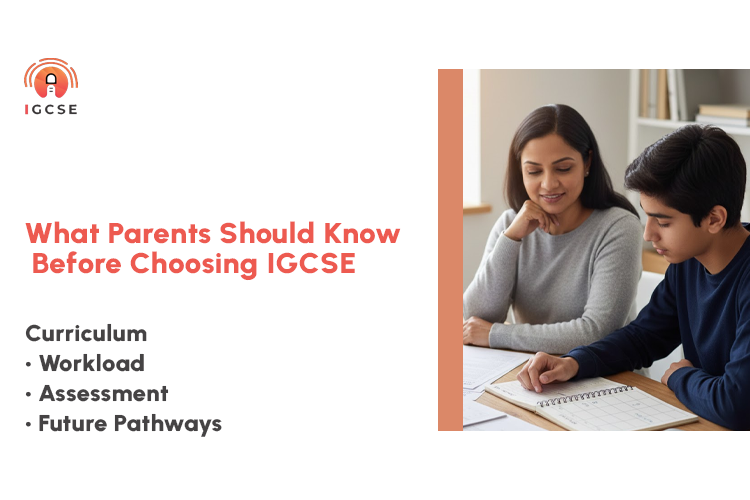
What Parents Should Know Before Choosing IGCSE for Their Child
Choosing a school curriculum is rarely a simple decision. Parents are not only selecting a syllabus, they’re choosing a learning style, assessment format, and academic pathway that can shape a child’s confidence for years. IGCSE is often seen as an international option with strong academic standards, yet it is not the best fit for every learner or every family. Before you commit, it helps to understand what the programme really demands, how it is assessed, and what support might be needed at home.
What IGCSE actually is
IGCSE stands for International General Certificate of Secondary Education. It is usually taken in Grades 9 and 10 (or Years 10 and 11 in some systems). It is offered in many subjects, and it is recognised by schools and universities across countries. The curriculum is designed to build concept clarity, application-based learning, and exam readiness through structured content and clear assessment objectives.
Who IGCSE suits best
IGCSE tends to work well for students who:
- learn best through understanding and application rather than memorising
- are comfortable with regular practice, especially in Maths and Sciences
- can manage multiple subjects with consistent weekly study habits
- benefit from a curriculum that balances writing, problem-solving, and analysis
It can also suit students who may later move to IB programs, A Level Exam pathways, or other international boards, since the skills developed in IGCSE (analysis, structured responses, exam technique) transfer well.
The workload is consistent, not last-minute
One of the biggest misconceptions is that IGCSE can be managed with short bursts of study close to exams. In reality, the strongest results usually come from steady, spaced learning. Parents should expect:
- ongoing practice in Maths and Science
- frequent revision of past topics, not just current chapters
- timed writing practice for English and humanities
- regular use of past papers as exams approach
This does not mean a child must study for hours every day. It means learning needs to be planned, repeated, and maintained.
Understanding subject choices matters
In many schools, IGCSE offers flexibility in choosing subjects. Parents should look past what seems popular and focus on what aligns with:
- the child’s strengths and interests
- future academic plans
- university requirements in the country you are considering
A common mistake is selecting subjects without understanding prerequisites. If a child is likely to move into STEM later, choices like Maths, Physics, Chemistry, and Computer Science are often more supportive. If they are considering humanities or social sciences, subjects like Economics, Business Studies, Geography, and strong English can be useful.
Assessment style: what your child will be judged on
IGCSE assessments reward method and clarity, not just final answers. In Maths and Science, marks are often given for working steps. In English and humanities, marks depend on structure, evidence, vocabulary, and how ideas are developed.
Parents should know that exam success is strongly linked to:
- knowing how to answer different question types
- learning mark scheme language and expectations
- practising under timed conditions
This is why many students benefit from structured support, whether through school guidance, IGCSE online tutoring, or igcse online coaching during exam seasons.
Why past papers matter more than extra textbooks
Parents often invest in many books, thinking that more content equals higher scores. In IGCSE, past papers and mark schemes are often the biggest score driver. Past papers help students learn:
- how questions are framed
- what examiners reward
- how much working is required
- how to manage time under pressure
A simple home habit that helps is scheduling one past-paper section per week per core subject, followed by careful marking and corrections.
The role of English is bigger than most parents expect
Even if a child is strong in Maths and Science, English can affect overall performance because it supports:
- reading speed and comprehension
- understanding complex worded questions
- writing clarity in humanities and Science explanations
If a child struggles with vocabulary, reading stamina, or structured writing, early support can prevent stress later. This does not always mean heavy tuition. It can mean building reading habits, practising short writing tasks weekly, and learning how to plan answers.
Maths and Science need skill-building, not rote learning
Parents often ask whether IGCSE Maths is “hard”. The better question is whether the child has a steady practice routine. Maths improvement comes from:
- repeating question types until methods become automatic
- fixing common errors through correction cycles
- practising mixed questions regularly
The same applies to Science. Success is built through concept clarity plus exam technique. If your child is taking Physics, the approach changes again because accuracy with units, formulas, graphs, and wording becomes essential. Families that choose igcse physics tuition usually see the best results when the tuition focuses on exam method and marking, not only re-teaching chapters.
Online support: when it is useful and when it isn’t
IGCSE online tutoring can be helpful when:
- a child is stuck in a topic and needs personalised explanation
- marks are being lost due to technique, working, or wording
- revision needs structure, accountability, and a plan
- the student needs targeted practice under time pressure
Online igcse tuition is less effective when used as a substitute for self-study. Parents should treat tutoring as a tool to fix weak spots and improve exam performance, while keeping daily practice and revision habits in the student’s routine.
Cost, school culture, and fit
Beyond academics, parents should look at:
- how experienced the school is with IGCSE delivery
- teacher familiarity with marking standards and exam preparation
- class size and individual attention
- how much homework and testing is expected
- student wellbeing and pressure levels
An IGCSE school with strong systems will usually have clear revision schedules, internal assessments aligned to exam patterns, and consistent feedback.
Transition planning: what comes after IGCSE
Parents should consider the next step early:
- IB programs often follow IGCSE well because of the emphasis on analysis and independent learning
- A Level Exam paths can also match well, especially for students who prefer depth in fewer subjects
- Some students shift to national boards depending on local university pathways
A child’s subject combination in IGCSE can shape these options, so future planning should be part of the decision.
Final checkpoints for parents
Before choosing IGCSE, ask:
- Does my child learn best with concept-based learning and regular practice?
- Are we ready for steady workload over two years?
- Does the school have proven IGCSE results and exam preparation systems?
- Are subject choices aligned with future pathways?
- Do we have a support plan for English, Maths, or Science if needed?
IGCSE can be a strong choice when the fit is right. With the right school environment, a realistic understanding of the workload, and consistent habits at home, students often gain not only grades but confidence in how to learn, write, and solve problems under pressure.